
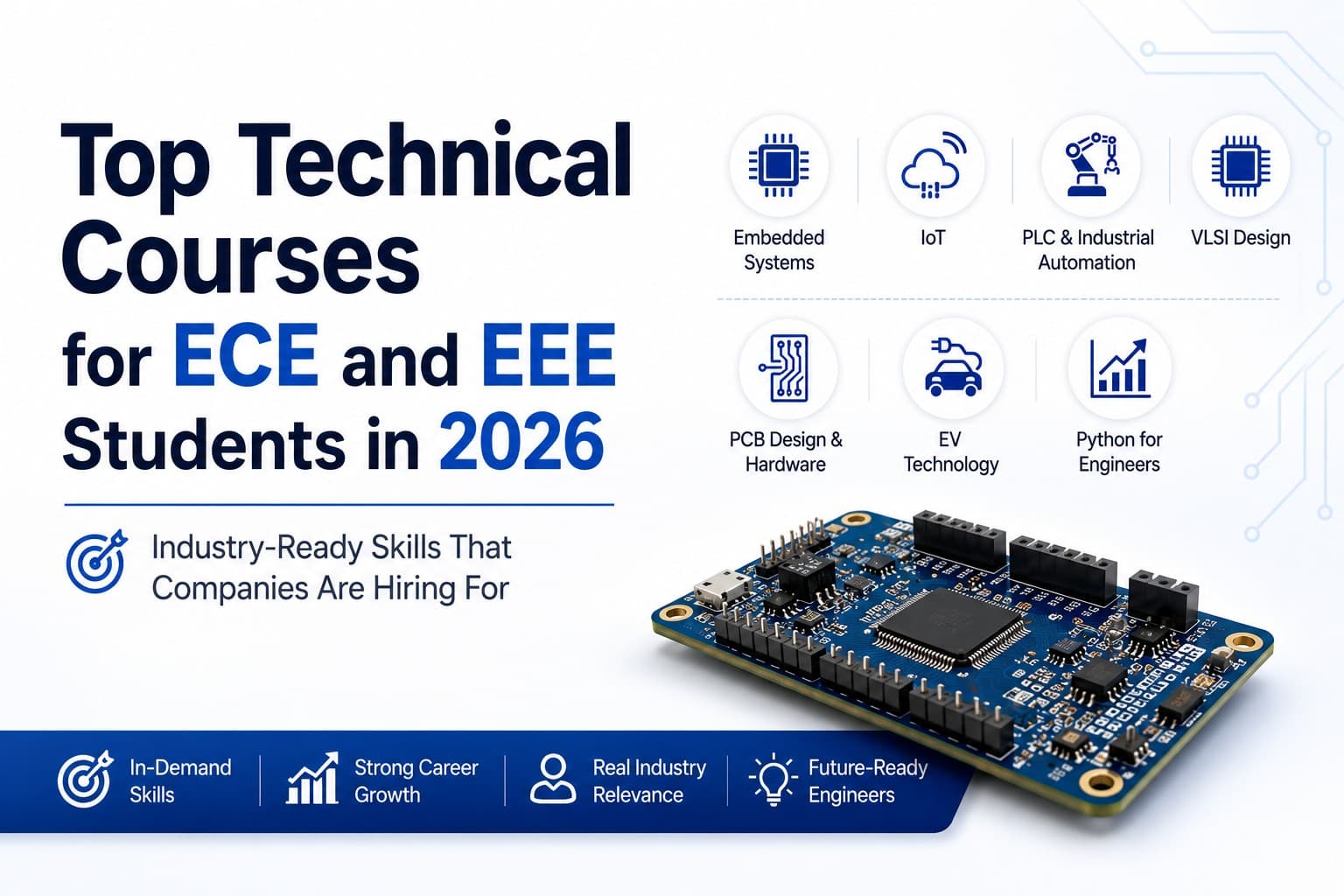
If you are an Electronics and Communication Engineering (ECE) or Electrical and Electronics Engineering (EEE) student, you have probably felt it: four years of engineering, a degree in hand, and still wondering whether you are actually ready to work.
You are not imagining the gap. According to the India Skills Report 2024, only around 45% of engineering graduates are considered employable in their core domain. That is not a talent problem — it is a training problem. College curricula are built around syllabuses, not industries.
The right technical course can genuinely change that. But choosing the wrong one — because of hype, marketing, or peer pressure — wastes both money and time.
This guide is written to help you choose honestly. Each section covers what you will actually learn, what salaries look like, who is hiring, and who each course is not right for.
Before picking a course, ask yourself two questions: Hardware or software? And Core or IT-adjacent? Your answers will point you to two or three paths — not all seven.
How to Read This Guide
Before diving in, answer two questions for yourself:
- Hardware or software? Do you prefer working with circuits, chips, and physical systems — or do you prefer writing code and working with data?
- Core or IT? Do you want to work in electronics/electrical/manufacturing industries — or are you open to IT-adjacent roles?
Your answers will point you to two or three courses in this guide. You do not need all of them.
1.Embedded System

Who it's for: ECE students, and EEE students with digital electronics exposure
Realistic entry salary: ₹3.5–6 LPA (fresher); ₹8–14 LPA (2–3 years experience)
Top hiring companies: Bosch, Continental, L&T Technology Services, Tata Elxsi, Sasken, Honeywell, Robert Bosch Engineering, NXP, Qualcomm India
Embedded systems is the backbone of every intelligent product you use — your car's ABS, your smart TV, your washing machine's control panel, the ventilator in a hospital ICU. Every product that does something "smart" has a microcontroller running firmware inside it.
What you actually learn:
- Microcontroller programming: 8051 (to understand architecture), ARM Cortex-M (the industry standard), STM32 (the most common development board)
- Embedded C — not the same as regular C; you need to understand registers, memory-mapped I/O, and hardware abstraction layers
- Communication protocols: UART, SPI, I2C, CAN. These are how chips talk to each other. CAN is especially important if you want automotive work.
- Firmware development: writing code that runs directly on hardware, without an OS
- Hardware debugging: oscilloscopes, logic analysers, JTAG, reading datasheets
What a good course looks like: You should be writing code that blinks an LED in week one and controlling a motor or reading a real sensor by week four. If a course spends the first month on theory, look elsewhere.
Honest caveats: Entry-level embedded roles have a learning curve — production firmware is not forgiving. Debugging a timing issue on a CAN bus at 2 AM is real work. The field is deeply satisfying if you like hardware but can be frustrating if you prefer high-level abstraction.
Strong pairing: Combine with IoT or EV Technology for a significantly broader job profile.
2. IoT — Internet of Things

Who it's for: ECE students; pairs well with Embedded Systems
Realistic entry salary: ₹3–5.5 LPA (fresher); ₹7–13 LPA (with embedded background)
Top hiring companies: Wipro, HCL, Siemens, Honeywell, ABB, ITC Infotech, Jio, Tata Communications, various smart-city project vendors
IoT is where embedded systems meet internet connectivity. The combination enables remote monitoring, industrial automation, precision agriculture, healthcare wearables, and smart infrastructure.
What you actually learn:
- Sensor integration and data acquisition (temperature, humidity, pressure, proximity, GPS)
- Wireless protocols: Wi-Fi, Bluetooth/BLE, LoRa (long range, low power — used in agriculture and smart meters), Zigbee
- Cloud connectivity: AWS IoT Core, Azure IoT Hub, Google Cloud IoT. You will learn how device data flows from hardware to cloud dashboard.
- MQTT protocol — the lightweight messaging standard that most IoT systems use
- Edge computing basics: processing data on the device rather than sending everything to cloud
What separates a strong IoT engineer from a weak one: Anyone can connect an ESP32 to Wi-Fi and push data to a dashboard. The difference-maker is knowing how to design for real constraints — intermittent connectivity, battery-powered devices, secure data transmission, and firmware updates over the air (OTA).
Honest caveats: The IoT job market is real but fragmented. Many roles are project-based (integrators, system vendors), which means less job stability than product companies. Pure IoT roles are fewer than Embedded or PLC roles; most IoT engineers also have embedded or cloud skills.
3. PLC and Industrial Automation

Who it's for: EEE students primarily; also ECE students with power or control systems interest
Realistic entry salary: ₹3–5.5 LPA (fresher); ₹8–16 LPA (3–5 years experience)
Top hiring companies: Siemens, ABB, Schneider Electric, Rockwell Automation, Honeywell, L&T, Thermax, Toyota, Hyundai Motor India, cement and pharmaceutical manufacturers
If you are an EEE student and have not yet decided on a course, read this section carefully. Programmable Logic Controllers (PLCs) run every factory floor in the world — automobile plants, cement factories, food processing units, power distribution systems, water treatment plants. Industrial automation is not a niche skill; it is the infrastructure of manufacturing India.
What you actually learn:
- PLC programming: Ladder Logic (the most common language), Function Block Diagram (FBD), Structured Text
- SCADA (Supervisory Control and Data Acquisition): software systems that monitor and control industrial processes
- HMI (Human-Machine Interface): designing the operator touchscreens that control a factory
- Motor drives and variable frequency drives (VFDs): controlling industrial motors
- Industrial communication: Modbus, Profibus, Profinet, EtherNet/IP
- Major platforms: Siemens SIMATIC S7, Allen-Bradley (Rockwell), Schneider Modicon
Why this course has exceptional job stability: Every manufacturing plant expansion, every Industry 4.0 upgrade, every new production line needs automation engineers. Unlike software roles, automation work cannot be easily outsourced — the engineer often needs to be physically present at the plant. This creates consistent local demand.
Honest caveats: Many roles require site visits and travel to industrial locations. The work is deeply rewarding for people who like seeing physical systems respond to their code, but less appealing to those who prefer office-only environments. Career progression is slower than IT but extremely stable.
Something worth knowing: India's manufacturing push under PLI (Production Linked Incentive) schemes is creating sustained demand for automation engineers in sectors like semiconductors, EVs, pharma, and defence. This is a 10-year tailwind.
4. VLSI Design
Who it's for: ECE students with strong digital electronics fundamentals; high commitment required
Realistic entry salary: ₹5–9 LPA (fresher with good skills); ₹15–30+ LPA (5+ years)
Top hiring companies: Qualcomm, Intel, Samsung Semiconductors, MediaTek, Micron (new Sanand facility), Cadence, Synopsys, Wipro VLSI, NXP, NVIDIA
VLSI (Very Large Scale Integration) is the field of designing chips — the actual silicon that everything else runs on. India's semiconductor ambitions are real: the India Semiconductor Mission has committed ₹76,000 crore in incentives, and companies like Micron, Foxconn-HCL, and Tata Electronics are setting up manufacturing and design facilities.
What you actually learn:
- Digital design using Verilog and VHDL (hardware description languages — not the same as software programming)
- RTL (Register Transfer Level) design: describing how data flows through logic
- FPGA-based prototyping: verifying designs on field-programmable hardware before tape-out
- Synthesis and timing analysis: converting RTL to gate-level and meeting timing constraints
- Chip verification: writing testbenches to verify your design works correctly
- Physical design basics: floor planning, placement, routing — how logic becomes physical layout
What distinguishes this path: VLSI has the highest salary ceiling of any path on this list. A principal engineer with 8–10 years of VLSI experience in India earns ₹40–80 LPA or more. The barrier to entry is higher, but so is the reward.
Honest caveats: This is the most academically demanding path on the list. You need genuinely strong fundamentals in digital electronics, boolean algebra, and computer architecture. A mediocre VLSI course will not get you hired at a chip company — the technical bar in interviews is very high. If your digital electronics foundation is weak, strengthen it before pursuing VLSI training. Also note: the number of VLSI roles is smaller than embedded or automation roles — competition for good positions is intense.
5. PCB Design and Core Hardware Electronics

Who it's for: ECE students interested in hardware product development or startups
Realistic entry salary: ₹2.5–4.5 LPA (fresher); ₹6–10 LPA (experienced, especially with embedded skills)
Top hiring companies: Electronics hardware startups, product companies, defence PSUs, ISRO vendors, contract electronics manufacturers
Every electronic product starts as a schematic and becomes a PCB. PCB design is the bridge between a circuit concept and a physical product. Hardware startups, defence contractors, and electronics OEMs need engineers who can take a design from schematic to a manufactured, testable board.
What you actually learn:
- Schematic capture: converting a circuit design into a formal schematic in tools like KiCad (free, industry-respected) or Altium Designer (industry standard at large companies)
- PCB layout: placing components and routing traces with attention to signal integrity, thermal management, and manufacturability
- DFM (Design for Manufacturability): designing boards that a contract manufacturer can actually build reliably
- Signal integrity basics: managing crosstalk, impedance, and noise in high-speed designs
- Component selection and BOM (Bill of Materials) management
- Design review and Gerber file generation for fabrication
Honest caveats: Standalone PCB design roles are relatively limited; most positions combine PCB design with embedded firmware work or hardware testing. If you pair PCB design with embedded systems, your employability jumps significantly. Also, PCB design skill is excellent for freelancing — hardware startups globally outsource schematic and layout work.
6. Electric Vehicle (EV) Technology

Who it's for: EEE students with power electronics interest; ECE students with embedded background
Realistic entry salary: ₹3.5–6 LPA (fresher); ₹9–18 LPA (3–5 years experience)
Top hiring companies: Ola Electric, Ather Energy, Tata Motors (EV division), Mahindra Electric, Hero Electric, Revolt Motors, Exicom, HELLA, Bosch, Continental
India is in the early stages of an EV transition that will take 10–15 years to play out. The companies building that transition — both OEMs and their Tier 1 suppliers — are actively building engineering teams.
What you actually learn:
- Battery Management Systems (BMS): the electronics that monitor cell voltages, temperatures, state of charge, and protect the pack from overcharge and overdischarge. This is genuinely complex engineering.
- Motor control: BLDC and PMSM motor control using FOC (Field Oriented Control) algorithms
- Power electronics: DC-DC converters, inverters, on-board chargers (OBC)
- CAN bus communication: how vehicle ECUs talk to each other
- Embedded control in vehicle systems: real-time control loops running on automotive-grade microcontrollers
- Functional safety basics: ISO 26262 concepts (increasingly expected at better companies)
Honest caveats: EV roles at good companies (Ather, Ola, Tata) are competitive. They look for candidates with both power electronics and embedded knowledge — the intersection is the differentiator. If you only have one, your options narrow. The EV ecosystem in India is still maturing, and some early-stage EV startups have had financial difficulties — research employers before joining.
7. Python and Data Analytics for Engineers

Who it's for: ECE/EEE students open to data-adjacent or software-heavy roles
Realistic entry salary: ₹3.5–6 LPA (fresher with good portfolio); ₹8–15 LPA (2–3 years)
Top hiring companies: Manufacturing analytics firms, energy companies, IT services with engineering analytics practices, industrial IoT companies, process industries
Engineering datasets are everywhere — sensor readings from a factory floor, power consumption logs, vibration data from machines, test results from production lines. Industries increasingly need engineers who can write Python to process, analyse, and extract insight from this data.
What you actually learn:
- Python fundamentals (data types, control flow, functions, file handling)
- NumPy and Pandas: numerical computing and tabular data processing
- Matplotlib and Seaborn: data visualisation
- Basics of scikit-learn: applying machine learning to classification and regression problems
- Industry applications: anomaly detection in sensor data, predictive maintenance, quality control analysis
Honest caveats: This is the most "IT-adjacent" course on this list. If your goal is a core electronics role, Python analytics is a useful supplementary skill but not a standalone differentiator. It is most valuable when combined with domain knowledge — an engineer who understands the underlying process and can write Python to analyse it is more valuable than a pure data analyst without that context.
What Separates Good Training from a Certificate
When evaluating any course, ask these questions before enrolling:
1. What hardware will I work with?
A legitimate embedded or PLC course should put real hardware in your hands — not just simulate it. Ask specifically which development boards, PLCs, or test equipment you will use.
2. What project will I complete?
You should build something end-to-end: a working embedded system, a functional PLC automation, a deployed IoT node. This is what you show in interviews.
3. Who are the instructors?
Industry experience matters more than academic qualifications for these courses. Ask where your instructor worked before teaching.
4. What does placement support actually mean?
"Placement assistance" varies enormously — from genuine industry connections to a single job fair. Ask specifically: how many students from the last batch were placed, at what companies, and at what salaries?
5. Is the curriculum current?
Embedded courses that still focus primarily on 8051 (without significant STM32/ARM content) are outdated. PLC courses that do not cover Siemens S7-1500 or EtherNet/IP are behind the industry.
How to Choose: A Simple Framework

Before You Enroll: 5 Questions to Ask
1. What hardware will I work with?
Choose a course that gives you hands-on experience with real boards and industrial hardware, not just simulation. Ask which development boards, sensors, modules, and PLCs you will actually use during training.
2. What project will I complete?
You need an end-to-end project that you can confidently explain in interviews. It could be a working embedded system, a deployed IoT node, or a functional PLC automation project.
3. Who are the instructors?
For practical engineering courses, industry experience matters. Instructors should be able to connect concepts with real-world applications, debugging methods, and industry workflows.
4. What does “placement support” actually mean?
Do not stop with the word “placement.” Ask for real details: previous batch placement data, companies students were placed in, salary ranges, interview preparation support, and how long support continues after course completion.
5. Is the curriculum current?
Technology changes fast. Embedded courses that still focus only on 8051 without STM32, ARM, IoT, or industry-relevant tools are outdated. Similarly, PLC courses without exposure to modern systems like Siemens S7-1200 or S7-1500 may not match current industry expectations.
A focused course completed well is more valuable than two courses done partially. Choose the path that matches your actual interest, not just what sounds impressive. Curiosity, consistency, and practical depth are the real predictors of engineering competence.
Still confused about which course to choose?
Choosing the right career path can be challenging, especially with so many options available. Get expert guidance tailored to your career goals, interests, and current industry demand.
Connect with Manfree Technologies today and take the first step toward building a successful engineering career.
👉 Visit: Manfree Technologies
Industry-Oriented Training | Hands-On Projects | Placement Support
#ECE#EEE#EmbeddedSystems#VLSI#CareerAdvice#Engineering2026#EVTechnology#IndustrialAutomation